By Katie Shepherd
March 12, 2025
The Tariff Transparency Act would require a study on possible price increases for food, medicine and energy.
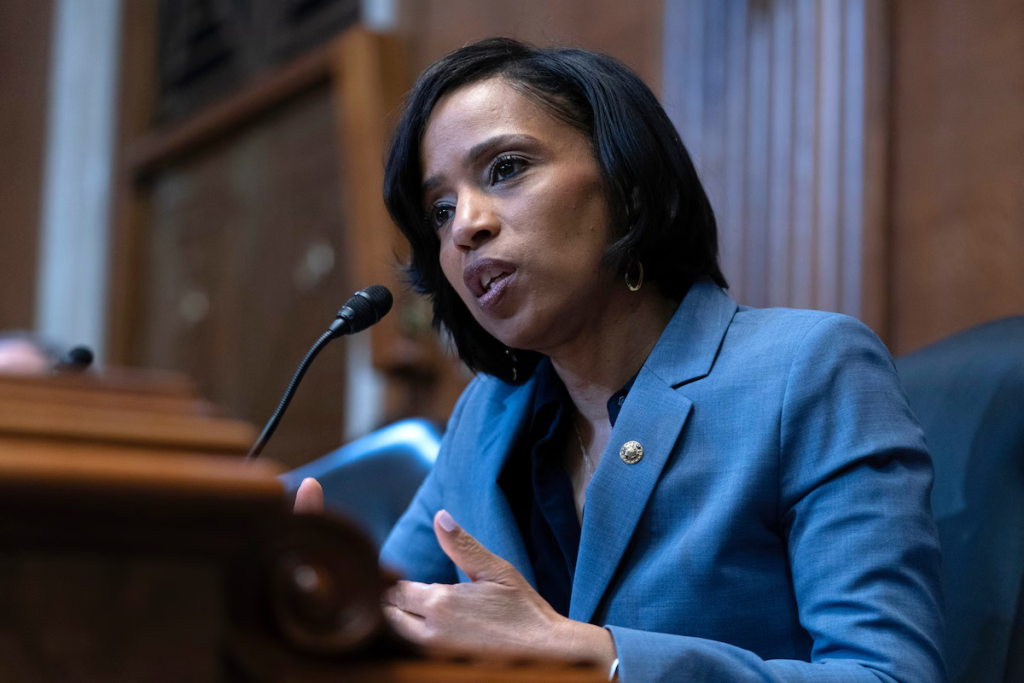
Sen. Angela Alsobrooks (D-Maryland) speaks last week on Capitol Hill. (Jose Luis Magana/AP)
Sen. Angela Alsobrooks (D-Maryland) on Tuesday night introduced her first piece of federal legislation since joining Congress this year, the Tariff Transparency Act, a jab at President Donald Trump’s tariffs on goods from Canada and Mexico.
The bill, which is co-sponsored by 16 other Democratic senators, would require the U.S. International Trade Commission (ITC) to launch a formal study of the consequences of those tariffs on consumers and businesses, including a look at potential price increases on food, energy, housing construction, automobiles, electronics and pharmaceuticals.
“The president keeps saying it is going to cause a minor disruption,” said Alsobrooks, who won her seat in November after serving as the Prince George’s county executive for six years. “That’s true unless it’s your kitchen table that’s impacted, unless it’s your groceries that have increased in cost.”
Since Trump announced tariffs on goods from Canada, Mexico and China in early February, those countries have struck back with retaliatory tariffs of their own, causing worries about a trade war that could plunge the U.S. economy into a recession.
China proposed a 15 percent tariff on U.S. farm goods and blacklisted more than 20 American companies. Mexico, which is especially reliant on trade with the United States, also promised to implement its own tariffs on U.S. products if Trump did not back down.
Canadian Prime Minister Justin Trudeau last week announced tariffs on more than $100 billion in U.S. goods; and Doug Ford, the premier of Ontario, Canada’s most populous province, announced a 25 percent tariff on energy exported to the United States. Trump on Tuesday responded by saying that he would double the tariff on Canadian steel and aluminum to 50 percent. Hours later, the two leaders appeared to be backing away from those threats, but the back-and-forth has confused CEOs and spawned a stock market slump.
Trump has argued that the tax on imports will boost the economy in the long term by bringing manufacturing jobs back to the United States, a goal that would require reversing decades of economic forces that pushed factories out of the country.
Alsobrooks said the uncertainty threatens to upend the economy and hit middle-class Americans the hardest. She said her bill would force the ITC to produce the data that would prove those fears correct.
Alsobrooks also said she does not believe the tariffs will provide any help to middle-class people, like her parents, who worked as a car salesman and a receptionist, which she often mentioned on the campaign trail last year.
“There is nothing that I’ve heard from this administration so far that attends to their needs,” she said. “This is instead about how to pay for the extension of these tax cuts for billionaires.”
Members of the Maryland business community have thrown their support behind Alsobrooks’s bill, though it faces an uphill climb in a Republican-controlled Congress.
Judy Gifford, who owns and runs a dairy in Kennedyville, Maryland, said the tariffs could cut off sales to some of the farm’s best customers and threaten farmers’ livelihoods.
The chaotic tariffs could also jeopardize small businesses, which “are the backbone of the economy,” said Herman Taylor, president of the Minority Business Economic Council. Other business advocates said the unpredictable consequences of the tariffs could leave businesses and consumers grappling with higher prices.
“The question on everyone’s mind is how will these tariffs impact everyday people,” Dewan Clayborn, president and chief executive of the Central Maryland Chamber of Commerce, said in a statement.
Although the Trump administration would not have to act on the study’s results, Alsobrooks said, she believes the data is important to have so the public can better understand the impact of the president’srapidly shifting economic policies.
“The Trump administration knows that these tariffs will raise prices and spike inflation and harm American businesses,” she said. “This is to force them to release the data publicly for the American people to understand what these tariffs will mean for our economy.”